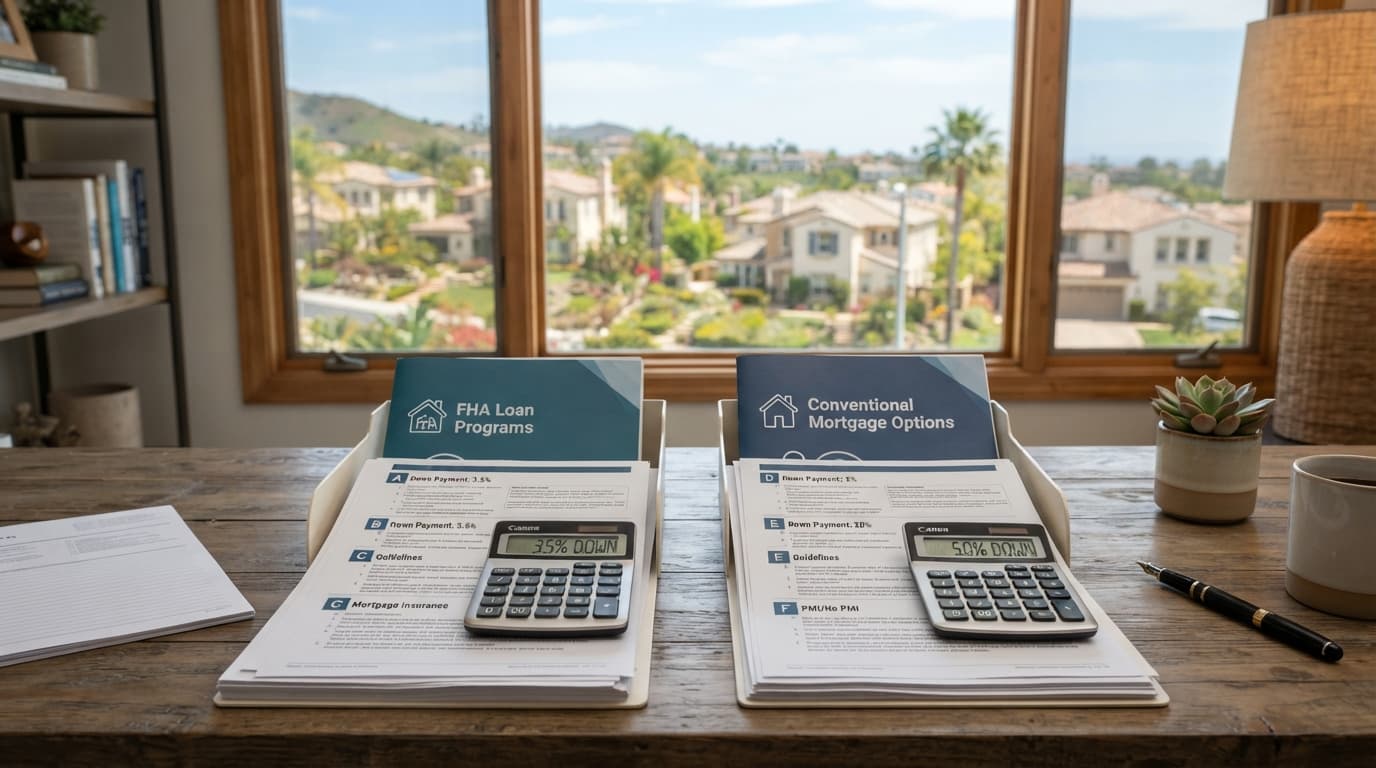
FHA vs. Conventional: Choosing the Right Purchase Loan
By Ben Cat · DRE #02030696 · NMLS #15970783 min read
Both loans can work, but their mortgage insurance, credit requirements, and costs differ. See how to compare FHA and conventional financing for your situation.
Choosing between an FHA loan and a conventional loan is one of the most common decisions homebuyers face. Neither is universally better. The right choice depends on your credit, your down payment, how long you plan to keep the loan, and how the costs add up.
The Basics
An FHA loan is insured by the Federal Housing Administration and is designed to expand access to homeownership, with flexible credit and low down payment requirements. A conventional loan is not government-insured and typically follows guidelines set by Fannie Mae and Freddie Mac for conforming loans. Both are made by private lenders.
Down Payment and Credit
FHA loans generally allow a down payment as low as 3.5 percent with a qualifying credit score, and they can accommodate borrowers with lower scores or limited credit history. Conventional loans may allow down payments as low as 3 percent for certain programs, but they tend to reward higher credit scores with better pricing. If your score is strong and your down payment is larger, conventional financing often becomes more competitive.
Mortgage Insurance: The Biggest Difference
FHA mortgage insurance premium (MIP) consists of an upfront premium, which can be financed into the loan, and an annual premium paid monthly. Under current rules, for many FHA loans with a down payment below 10 percent, the annual MIP lasts for the life of the loan. With a down payment of 10 percent or more, it may be removable after a period of time. The only way to eliminate lifetime MIP on a loan without removal is typically to refinance into a different loan.
Conventional private mortgage insurance (PMI) is required when your down payment is below 20 percent. Its cost depends on your credit score, down payment, and loan terms, and it can usually be canceled once you reach 80 percent loan-to-value through paydown or appreciation, subject to lender requirements, and it terminates automatically at 78 percent under federal law for most loans.
A Quick Comparison
- Credit flexibility: FHA is generally more forgiving.
- Mortgage insurance cost: FHA can be cheaper for lower-credit borrowers, while conventional PMI is often less expensive for higher scores.
- Cancellation: Conventional PMI is cancellable, while FHA MIP is often permanent.
- Property standards: FHA appraisals have stricter condition requirements, which can complicate purchases of fixer-uppers.
- Loan limits: Both have limits, and Orange County's are higher than the national baseline.
Total Cost Over Time
Compare the full cost over the period you expect to keep the loan, not just the initial payment. Ask your lender to show side-by-side scenarios including interest rate, mortgage insurance, upfront costs, and total interest paid at five, ten, and thirty years. A scenario that looks cheaper in year one may cost more over time.
Consider Your Plan
- If you may sell or refinance within a few years, the lifetime nature of FHA insurance matters less.
- If you plan to stay long-term and have solid credit, conventional may save money.
- If you need flexibility on credit or debt ratios, FHA may be the path to approval.
- If you are buying a home that needs repairs, check whether a renovation loan fits.
Do Not Forget Seller Perception
In competitive markets, some sellers view conventional offers as stronger because of fewer appraisal conditions. This varies, but your agent can advise how your financing type may be perceived.
Property and Appraisal Differences
FHA and conventional loans use different appraisal standards. FHA appraisers examine health and safety conditions in detail, while conventional appraisals focus more on value and general condition. If you are considering a property with peeling paint, a worn roof, or other issues, ask your lender how each loan type would treat them. The right loan can depend as much on the property as on you.
Compare Your Options
Run a Loan Comparison on the Mortgage Estimator at benvcat.org, and then talk with Ben Cat for a side-by-side analysis of FHA and conventional options based on your credit, savings, and goals.
This article is for general educational purposes and is not financial advice. Program rules change; confirm with your lender. Ben Cat, DRE #02030696, NMLS #1597078, Century Financial Group, Corp., DRE #01930905.
- #FHA loan
- #conventional loan
- #mortgage insurance
- #PMI
- #loan comparison
By Ben Cat, California Real Estate Salesperson (DRE #02030696) and Mortgage Loan Originator (NMLS #1597078), brokered by Century Financial Group, Corp. (DRE #01930905).
General information only, not legal, tax, or investment advice, and not an offer or commitment to lend. All loans are subject to credit and underwriting approval. Equal Housing Opportunity. Compare loan options · Disclosures.